Free Posture Analysis: What Two Photos Reveal About Your Body
Upload two standing photos and get an AI-powered posture score across 8 metrics. Learn what each measurement means and why it matters for your pain.
Free Posture Analysis: What Two Photos Reveal About Your Body
For years I tried to fix my posture the way most people do: guessing. I knew my neck hurt. I knew my lower back was tight. By 3pm most days I felt like I had been slowly crushed by an invisible weight. But I never had a clear picture of what was actually wrong.
I went to physical therapy. I went to the chiropractor. I tried massage, acupuncture, foam rolling. Some of it helped temporarily, but nothing stuck. I was treating symptoms without understanding the root cause. I didn't know which parts of my posture were off, by how much, or which ones were actually driving the pain.
That frustration is why I built a free posture analysis tool. Two photos. Eight measurements. A real score. No guessing.
Why Most People Have No Idea What Their Posture Actually Looks Like
The uncomfortable truth about posture is that you cannot accurately assess your own.
When you look in a mirror, you unconsciously straighten up. You cannot see your own side profile without twisting, which changes your alignment. And even if someone tells you that you slouch, that does not tell you what specifically is off or how far it has drifted from where it should be.
Most people just live with it. A study of over 1,100 people found that only 2.8% had ever consulted a specialist for a posture assessment, and 79.6% had never done any kind of postural exercise at all (Montuori et al. 2023).
Meanwhile the damage adds up. Research shows 80.81% of office workers experience musculoskeletal disorders, with neck pain at 58.6%, lower back pain at 52.5%, and shoulder pain at 37.4% (Scientific Reports 2025).
Photo-based posture analysis bridges that gap between "I think my posture is bad" and "here is exactly what is wrong." And it is not guesswork. A 2022 study found that computer vision-based posture analysis achieved 94% conformity with radiographic (X-ray) assessment across 140 participants (Kim et al. 2022).
A photo can tell you almost as much as an X-ray about your alignment, without the radiation, the cost, or the doctor's office.
How the Free Posture Analysis Works
The process takes about 60 seconds.
You upload two standing photos of yourself, one from the front and one from the side. The AI detects your anatomical keypoints automatically. No stickers, no markers, no special equipment. Just you, standing naturally.
From those two images, the tool calculates 8 specific posture metrics and generates an overall Postural Health Reserve (PHR) score from 0 to 100. The higher the score, the better your alignment.
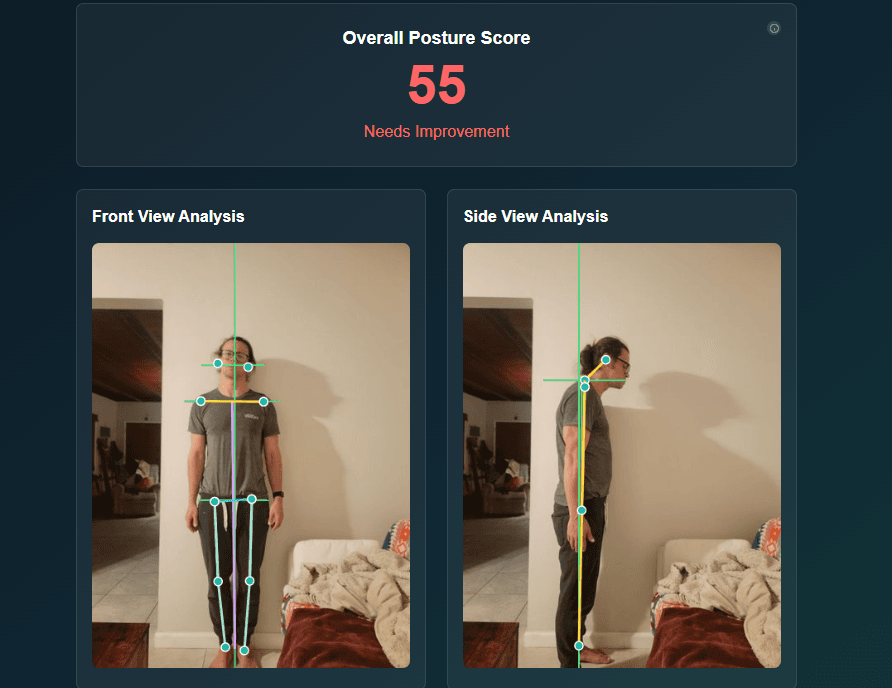
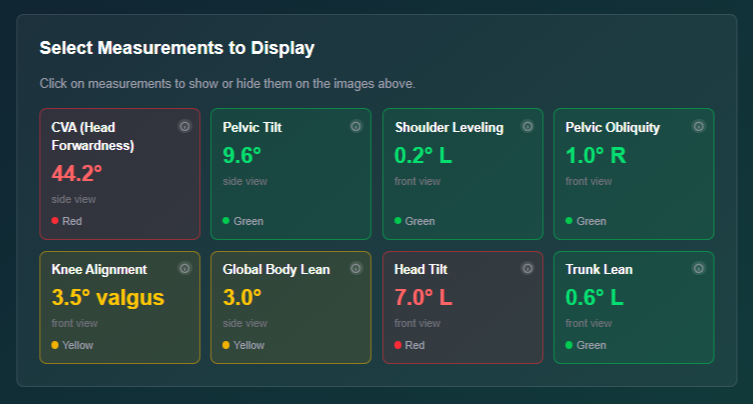
You get back your annotated photos with lines drawn over your body showing exactly what was measured, plus a color-coded breakdown of every metric. Green means you are in a healthy range. Yellow means there is room for improvement. Red means that area needs attention.
It is a free posture analysis that gives you real data, not vague advice.
Want to see your own numbers? It takes about 60 seconds — try the free posture analysis here.
The 8 Metrics and What They Mean for Your Body
Most posture apps just tell you "your posture is bad" and leave it at that. That is not useful. You need to know which specific things are off and why they matter. So here is what the analysis actually measures.
Head Forwardness (CVA)
This is the big one for desk workers. The Craniovertebral Angle measures how far your head has drifted forward relative to your shoulders.
When your ears are stacked directly over your shoulders, your head weighs about 10 to 12 pounds. But for every inch it shifts forward, the effective load on your cervical spine jumps. At just a 30-degree tilt, your neck is handling roughly 40 pounds (Hansraj 2014).
If you code, design, or do any kind of deep focus work, there is a good chance your CVA score is the metric that will light up. I wrote an entire deep dive on the physics of forward head drift and why it causes chronic neck tension if you want to understand the mechanics.
Pelvic Tilt
Your pelvis is like a bowl that holds up your spine. Pelvic Tilt measures whether that bowl is tipping forward (anterior tilt) or backward (posterior tilt) when viewed from the side.
Anterior pelvic tilt is extremely common in people who sit for long hours. When your hip flexors shorten from sitting all day, they pull the front of your pelvis downward. That increases the curve in your lower back and compresses the lumbar spine. You feel it as that deep, achy low-back pain that builds throughout the afternoon.
Shoulder Leveling
This metric measures whether one shoulder sits higher than the other. Even a small difference, a couple of degrees, can indicate scapular imbalances or habitual one-sided tension.
If you always mouse with one hand, carry a bag on one shoulder, or lean to one side while working, your shoulder leveling score will reflect it. Over time, this asymmetry can create uneven neck tension and contribute to headaches.
Pelvic Obliquity
Similar concept to shoulder leveling, but for your hips. Pelvic Obliquity measures whether one hip is sitting higher than the other.
A lateral hip hike can cascade downward — your knees and ankles compensate for the unevenness above, which can create pain patterns that seem completely unrelated to your pelvis.
Knee Alignment
This measures valgus (knock-knee) or varus (bow-legged) deviation, meaning how much your knees angle inward or outward from a straight line.
Poor knee alignment changes how load distributes through your legs when you stand and walk. It often connects back to hip and pelvic positioning.
The Supporting Cast: Body Lean, Head Tilt, Trunk Lean
These three ancillary metrics round out the picture:
- Global Body Lean measures whether your center of gravity is shifted forward or backward when viewed from the side.
- Head Tilt measures lateral neck flexion — whether your head tips to one side.
- Trunk Lean measures whether your torso shifts laterally over your base of support.
They carry less weight in the overall score than CVA or Pelvic Tilt, but they still flag asymmetries and shifts worth paying attention to. Sometimes a small trunk lean or head tilt is the missing piece that explains a persistent ache.
What Your Score Actually Tells You
The overall Postural Health Reserve score is not just an average of the 8 metrics. It uses a weighted penalty system designed to reflect how your body actually works.
CVA and Pelvic Tilt carry 1.5x weight because they affect the most people and cause the most pain. Shoulder Leveling, Pelvic Obliquity, and Knee Alignment carry standard weight. The ancillary metrics (Body Lean, Head Tilt, Trunk Lean) carry 0.5x weight.
Scores in the red zone also carry exponentially higher penalties. A mild yellow on one metric barely moves the needle, but a deep red on CVA will pull your overall score down fast. That level of forward head drift is genuinely hard on your body.
The color coding keeps it simple:
- Green: healthy range, no immediate concern
- Yellow: room for improvement, worth addressing over time
- Red: this area needs attention and is likely contributing to pain or dysfunction
A score of 72 does not mean you are broken. It means there are specific areas where targeted improvements will make a real difference in how you feel.
From Score to Action: What to Do With Your Results
The annotated photos show you exactly where your body deviates from healthy alignment. Most people have never seen an objective view of their own posture, so this is often an eye-opener.
The free results give you your overall score and a breakdown of all 8 metrics. You can see at a glance which areas are green, which are yellow, and which are red.
If you want to go deeper, there is an option to generate a detailed PDF report with personalized exercise recommendations sorted by your worst-scoring metrics. Red flags get addressed first with targeted stretches and strengthening exercises, then yellow areas. It turns your score into a plan.
Even without the report, knowing your numbers changes how you think about your body. If you discover your CVA is in the red, you can start with the micro-resets and chin tucks I covered in the tech neck post. If your Pelvic Tilt is the culprit, you know to focus on hip flexor stretches and core activation instead of more neck massages. The Posture Pomodoro app has the posture analysis built in, plus guided exercises during your work breaks to help you actually fix what your score reveals.
Once you understand the hidden posture problem for desk workers, measuring it is the obvious next move. And once you have the numbers, you actually know what to fix.
Your posture tells a story about how you work, how you sit, and how your body has adapted over time. Try the free posture analysis and see your scores in under a minute.