
Tech Neck Exercises: A 4-Minute Fix for Forward Head Posture
Four evidence-backed tech neck exercises that fix forward head drift from screen time. A 4-minute routine with measurable results in 4 weeks.
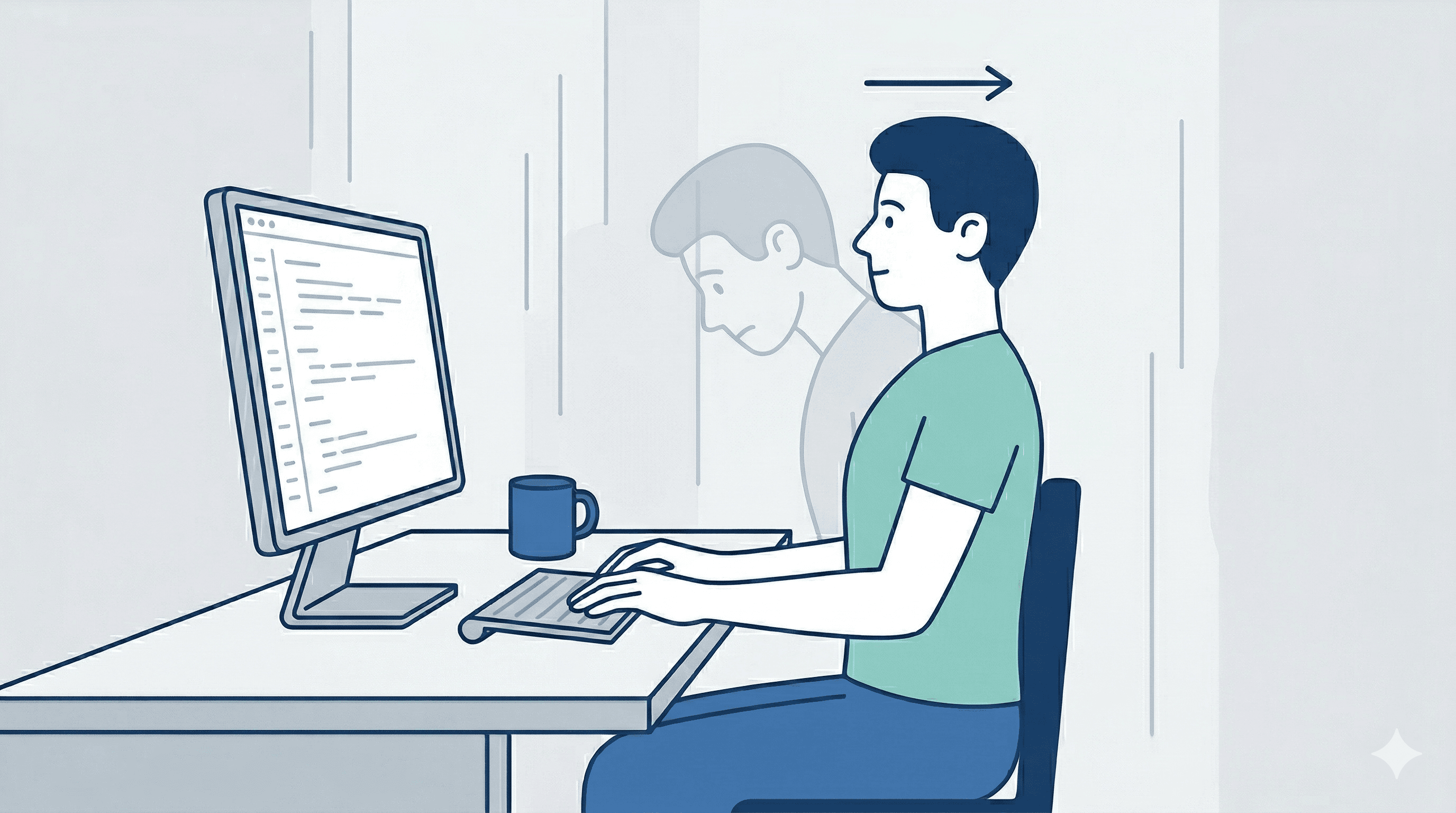
After I wrote about the physics of forward head drift and why it wrecks your neck, the most common response I got was some version of: "Okay, I get it. My head weighs 40 pounds when I lean in. Now what do I actually do about it?"
Fair question. Tech neck, also called text neck, is what happens when you spend years leaning toward a screen. I had the same reaction when I first understood what was happening. Knowing that your upper traps are on fire because your deep neck flexors have checked out is useful information. But it does not fix anything. You need specific tech neck exercises that target the specific muscles involved.
I spent a lot of time digging through the research on this, and working with my own physical therapist to fix my own tech neck. Not the random YouTube stretches, not the "10 exercises for better posture" listicles. The actual randomized controlled trials, combined with what actually worked for me. The core routine is four exercises in four minutes, but the real key is building movement into your whole day, not just doing one session and sitting still for the next eight hours.
Here is the routine.
Why "Just Sit Up Straight" Doesn't Fix Tech Neck
Willpower is not a posture strategy.
When you are deep in focused work, whether it is a spreadsheet, a long email chain, a design review, or a coding session, your brain does not care about your spine. It cares about the task. Your focus narrows, your head creeps toward the screen, and within 20 minutes you are right back where you started.
This is also why posture reminder apps do not actually fix anything. The ones that watch you through your webcam and ping you when you slouch, apps like SitApp and other posture detectors, can tell you that your posture is bad. But knowing your posture is bad is not the problem. You already know that. The alert goes off, you sit up straight, and ten minutes later you are leaning forward again because nothing has changed in your body.
Forward head posture is not a discipline problem. It is a muscle imbalance. Your upper traps and pecs have tightened from years of hunching. Your deep neck flexors and lower traps have weakened from years of not being used. That imbalance physically pulls you forward. No amount of alerts or reminders will fix shortened muscles. You have to fix the imbalance itself, stretching what is tight and strengthening what is weak.
The 4 Tech Neck Exercises That Actually Have Evidence Behind Them
I am not going to give you a list of 15 exercises and tell you to "pick a few." That does not work.
A 2022 review of three randomized controlled trials found strong evidence supporting four specific exercises for correcting forward head posture. These are the four. They target the exact muscles involved in the Upper Crossed Syndrome pattern that pulls your head forward.
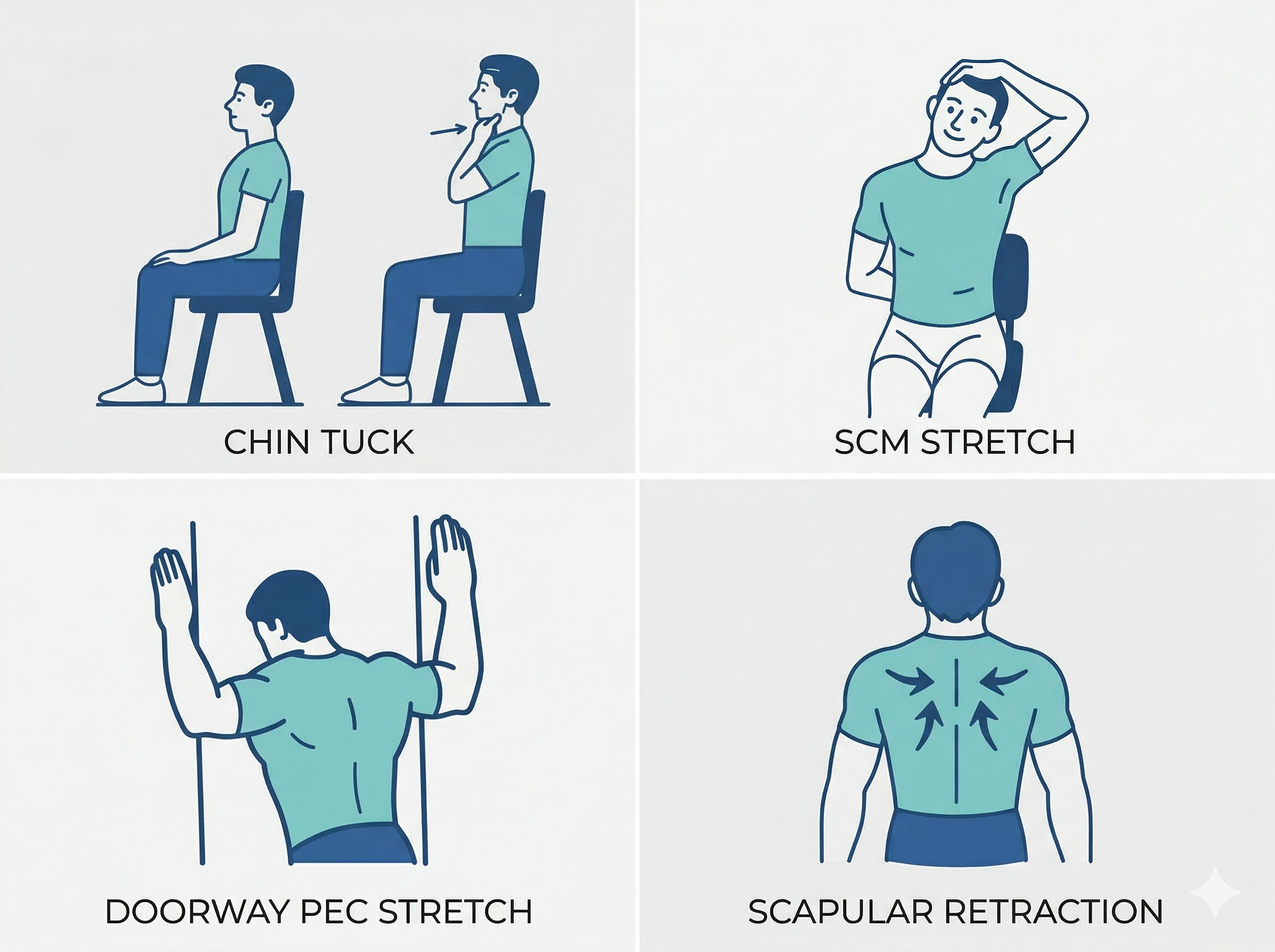
1. The Chin Tuck — Wake Up Your Deep Neck Flexors
This is the single most important tech neck exercise. Your deep cervical flexors are the small stabilizing muscles that hold your head in alignment over your shoulders. If you work at a desk, they have probably been dormant for years. Chin tucks wake them back up.
How to do it:
- Sit upright in your chair. Look straight ahead.
- Without tilting your head up or down, pull your chin straight back. Think "make a double chin." You should feel your head glide backward over your shoulders.
- Hold for 5 seconds.
- Release and repeat. 10 reps.
The motion is small. Your chin stays level. You are not looking down, you are pulling your head straight back, like someone gently pushed your forehead.
Tip: These are perfect during dead time. Waiting for a file to download, sitting on hold, between meetings. I do mine while waiting for code to compile. Thirty seconds of chin tucks during downtime adds up fast.
2. Upper Trap/SCM Stretch — Release the Side and Front of Your Neck
Your upper trapezius and sternocleidomastoid (SCM) run along the side and front of your neck. Hours of leaning toward a screen shortens and tightens both of them. They become two of the primary forces pulling your head forward.
How to do it:
- Sit or stand upright.
- Tilt your head to the right, bringing your right ear toward your right shoulder. You can gently use your right hand to pull your head further into the stretch.
- Hold for 20-30 seconds.
- Switch sides.
To hit the SCM more directly, add a slight rotation after tilting. Look slightly upward and away from the side you are stretching. You should feel the stretch shift from the top of your shoulder toward the front of your neck, from below your ear down to your collarbone. Do both variations if you have time. The basic tilt gets the trap, the rotated version gets the SCM.
Do not force it. You are not trying to touch your ear to your shoulder. A gentle stretch is all you need.
3. Pec Stretch (Doorway or Corner) — Open Up the Chest
Tight pectorals are the front half of the Upper Crossed Syndrome pattern. When your pecs shorten, they pull your shoulders forward and round your upper back. That rounding pushes your head even further forward to compensate. You cannot fix tech neck without addressing the chest.
How to do it:
- Stand in a doorway or face a corner.
- Place your forearms on the doorframe (or both walls if using a corner), elbows at roughly shoulder height.
- Step one foot forward and lean your chest through the opening until you feel a stretch across your chest and the front of your shoulders.
- Hold for 30 seconds.
If you have been sitting at a desk for years, the first time you do this stretch you will probably think "oh, that's where all my shoulder tension is coming from." Your pecs have been slowly pulling you into a hunch and you did not notice because it happened gradually.
4. Scapular Retraction — Strengthen the "Posture Engine"
Most people skip this one, but it is the most important for long-term correction. Stretching feels good in the moment. Strengthening is what actually changes your resting posture.
Your rhomboids and mid/lower trapezius hold your shoulder blades back and down. In the Upper Crossed pattern, they have been shut off while your upper traps do all the work. Scapular retractions wake them up.
How to do it:
- Sit or stand with your arms at your sides.
- Squeeze your shoulder blades together, as if you are trying to pinch a pencil between them.
- Hold for 2 seconds at full squeeze.
- Release slowly. 10-15 reps.
Keep your shoulders down while you squeeze. The most common mistake is shrugging up toward your ears, which just activates the upper traps again. Those are the muscles you are trying to give a break.
The 4-Minute Daily Tech Neck Routine — Put It All Together
Here is the exact sequence. Four minutes, every day.
| Minute | Exercise | Details |
|---|---|---|
| 0:00 – 1:00 | Chin Tucks | 10 reps, 5-second holds |
| 1:00 – 2:00 | Upper Trap/SCM Stretch | 30 seconds each side |
| 2:00 – 3:00 | Pec Stretch | 30 seconds each side |
| 3:00 – 4:00 | Scapular Retractions | 15 reps, 2-second holds |
I like to do mine as a midday break, after lunch or between focus blocks when I need to get out of my chair and move. Four minutes standing next to my desk. It fits perfectly into a Pomodoro break.
The order matters. You start with chin tucks to activate the deep neck flexors. Then you stretch the two muscle groups pulling you forward (upper traps/SCM and pecs). Then you strengthen the muscles that hold you back (scapular retractors). It follows the same activate-lengthen-strengthen progression that the NASM Corrective Exercise Continuum uses, compressed into a practical daily format.
Consistency beats intensity. A few four-minute sessions spread through the day will do more for your posture than a 30-minute block once a week. Your muscles need the repeated signal.
How Fast Does This Actually Work?
I am not going to promise you perfect posture in a week. But the research is encouraging.
A 2023 randomized controlled trial with 79 participants found that a corrective exercise program (self-myofascial release, stretching, and strengthening, the same categories in this routine) improved the craniovertebral angle by 3.1 to 4.4 degrees in four weeks. The control group improved by only 0.8 degrees. Stretching alone improved CVA by 3.8 degrees. Adding strengthening brought it to 4.4.
A few degrees might not sound like much. But a few degrees of CVA change is the difference between your neck handling 40 pounds of load and handling 30. That is a real reduction in the mechanical stress that causes the burning, the tightness, and the headaches.
Multiple studies showed significant pain reduction too. One trial found the exercise group had greater functional improvement than the control group (Sikka et al. 2020).
Realistic timeline: your neck should feel noticeably better within 2-3 weeks. Measurable change in head position within 4 weeks. More significant structural changes over 6-12 weeks of consistent daily practice.
Why Fixing Tech Neck Matters More Than You Think
In the previous post on tech neck, I covered a concept called ligament creep. It is the slow, physical stretching of the ligaments in your neck from holding a forward position for hours. Unlike muscles, ligaments do not snap back easily. Once they stretch, your neck loses structural stability.
The four-minute routine targets the specific muscle imbalances that cause The Drift. Stronger deep neck flexors hold your head back. Loosened pecs and SCMs stop pulling you forward. Active rhomboids and lower traps keep your shoulders from rounding. Your muscles start doing the work so your ligaments do not have to.
A 2023 study of 73 IT professionals found that the average craniovertebral angle in the group was 32 degrees, well below the 50-degree threshold that indicates tech neck. These were young professionals, average age 32, with less than 10 years of desk work. Their posture was already significantly off.
If you sit at a screen for a living, the math is not in your favor. The longer you wait, the harder the correction becomes.
Knowing the exercises is one thing. Actually doing them every day is another. That is why I built the Posture Pomodoro mobile app. It pairs timed Pomodoro work blocks with guided posture exercises during your breaks. Instead of relying on yourself to remember the routine, the app delivers the right exercises at the right time. Join the beta and try it for free.